Monday, October 28, 2013

Alhambra!

Yes! I got in! Without having procured a ticket in advance! Here's what I had to do:

I got in a taxi at 6:30 am and by 6:45 I was standing in line, in the dark, waiting for the Alhambra ticket office to open at 8:00 am. There were about 8 people in line ahead of me. Conversations, such as they were, were very quiet .... in Spanish, German, French...

For the first 45 minutes we stood in darkness, the line behind me growing. It was cold; we were all wearing jackets. A couple from Australia came to stand right behind me, and they were my salvation! We chatted happily and the time flew. Around 7:30, the lights inside the building went on! 

Look! They've turned the lights on inside!
By 8:00, when the doors opened, it was already light outside and there were hundreds of people behind me in line.

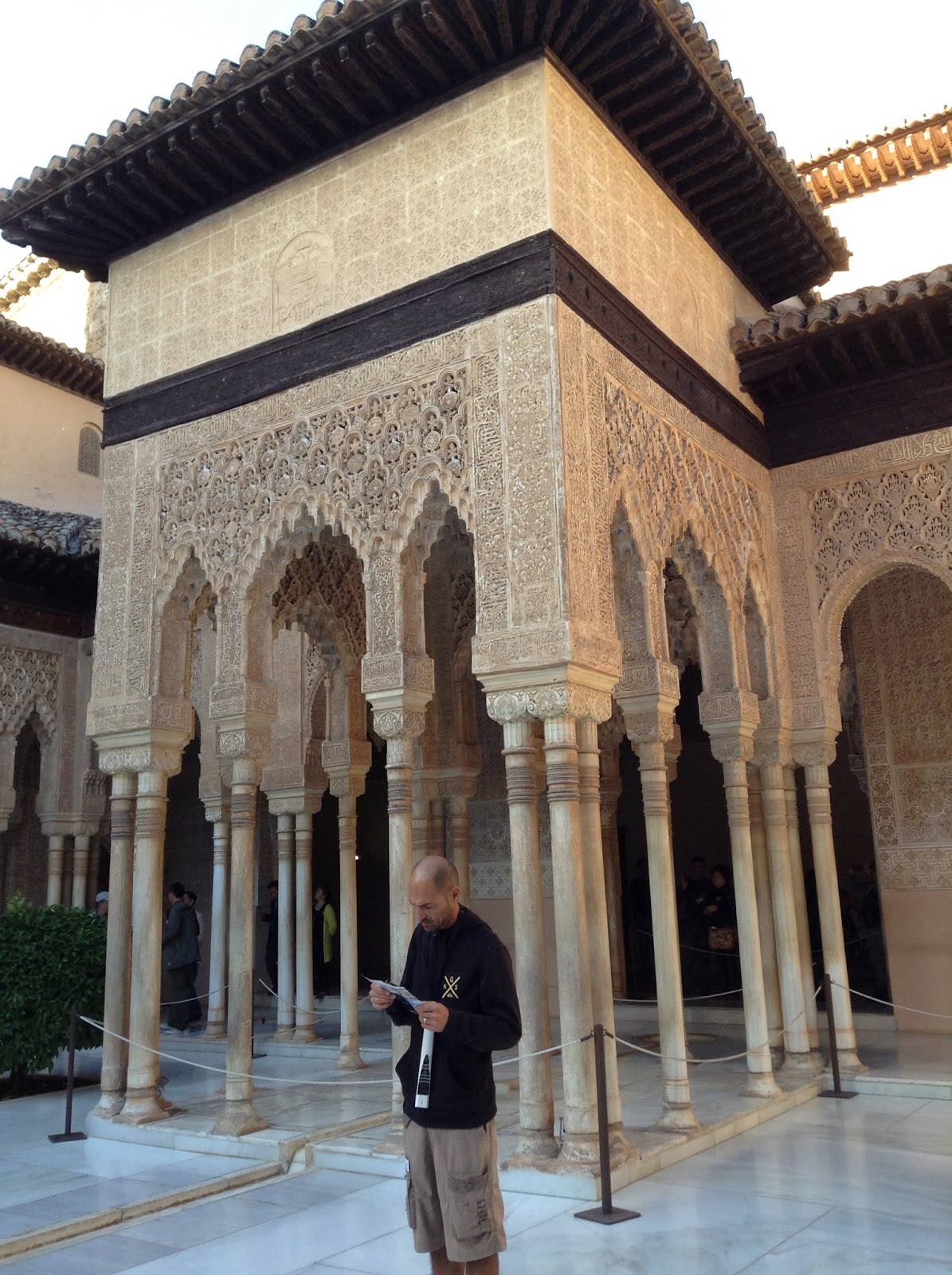
There is no way that my little photographs can capture the grandeur of this place, the magnitude. From the outside, it doesn't look like much more than a big fort. Inside, it's a wonder of light and grace, of lacy detail carved into every inch of stone on the walls, and into wood on the ceilings. Here are some little corners:


This is looking up into a corner at the ceiling in one of the rooms.  That's not wallpaper — it's carved stone.


Look up at the ceilings! They're carved out of wood. And the ceiling of each room is different.
And then there's this ceiling!


And then... look down at the floors!  These tiny little tiles, one-of-a-kind.  Is this a radish?  A beet?
(Thanks to Betsy and Nina, who point out that this is a POMEGRANATE! Of course! The apple of Granada!)


Between rooms...   graceful outdoor patios
and gardens...
reflecting pools...
and little peeks at the outside world. 
Outside the Alhambra proper, I walked through the "Wine Gate," which inspired Claude Debussy to write his "Puerta del Vino."


The Puerta del Vino separated the Alhambra from the Medina — the old city, long ago demolished. What remains is the ruins of the city and the fortress.  It was fun to climb it!

Yes, I climbed to the top of that tower! Very slowly!


At the very top!
Here are the two young Australians, Martina and Ruben. We kept running into each other as the morning progressed.


At the very end of the Alhambra, a walk through the Generalife Gardens, graced by the all-important water.

Come here if you can. Bring a friend along. And get your ticket well in advance!

Saturday, October 26, 2013

Granada outside the Alhambra

Ach. It's been an arduous day, and disappointing. It began all right, with a two-hour train ride from Córdoba to Granada.


Through the window of the train I saw mile after mile of olive orchards, mountains in the distance.

Once in Granada, I decided to walk to my hotel instead of taking a taxi. On the map, when I glanced at it last night, it looked like a very short walk. Hah! It was not short. And I had to ask directions several times. (Asking directions turns out to be not hard to do. People here are friendly and eager to help.)

By the time I finally reached the hotel around 2:00 pm I was tired and very hungry. I found myself terribly annoyed to find that no one was there to greet me at the door. The hotel office was up a flight of marble stairs. No elevator. And then... my room is up yet another flight of stairs! Helen F would see this as a benefit, an exercise opportunity. I wanted an elevator!

Getting off to a late start, map in hand, still crabby, I started out on a 40-minute walk to the Alhambra. Along the way, a cold beer and a plate of salmon cheered me up and convinced me I could walk all the way up. I crossed through a few crowded, noisy plazas in the city, full of shops and restaurants. One of the shops sold spices in bulk, many baskets right out on the sidewalk.


The moment I entered the grounds of the Alhambra the bustling world fell away. I was surrounded by green, and by the sound of bubbling water. The steep path — I mean STEEP — has water running along both sides through stone channels.


The sound of the rushing water is LOUD as it cascades over  steps and boulders.

Oddly enough, Washington Irving inhabits this steep path. His writing of Tales of the Alhambra in 1829 had something to do with the decision to restore the palace after years of abandonment.

My plan was to purchase a ticket for tomorrow, since it was now about 4:00 and today was just about shot. However, when I got to the ticket window at the very very top of the high hill, I was told that one must buy one's ticket on the day it will be used. All the tickets for today were sold out, of course. I could buy a ticket in advance via the internet, however the first available day will be November 6. OR... I could come back tomorrow, stand in line beginning at 6:30 am, and buy a ticket for tomorrow when the window opens at 8:00. They do reserve a small number of tickets for those who wish to purchase on site. 

Oh.  

Pondering this, I chose not to retrace my steps but to walk behind the Alhambra in the direction of the old Muslim area called Albaicín. Almost immediately, this sign — or rather, its English translation — caught my attention:


I walked downhill behind the Alhambra along a stone path, accompanied by more gurgling streams. 


I took some videos so that you could hear the sound, but belatedly realize that videos don't work on this blog.  Alas.
I was delighted to see olive trees along this path, having only seen them from a distance on the train.


Can you see the tiny little green olives?
Walking downward along this stone path was lovely, but my feet began to hurt. The stones dug in, even through the soles of my heavy boots.

You can see Albaicín off in the distance. It's high on a second hill, separated from the Alhambra by the Río Darro.
I reached the bottom and crossed the little Río Darro. My feet hurt and there I was, facing the high hill of Albaicín. What could I do? I had to climb it! Yet more stone paths, these now going UP.

Good things about this walk: The views are terrific. 

View of the Alhambra from half-way up the hill in Albaicín

The people you run into — from all over Europe, and also one lovely man from Ghana — are fun to talk to. We help each other, as we are all pondering our maps, each one of us as lost as the other in this warren of stone streets running up and down, streets often turning into steps.

By 7:00 I was back down in the city and in a funk. What to do? Do I really want to get up at 6:00 and walk through dark and deserted streets into the city center, hoping to find a taxi at that hour to take me back up the hill to the Alhambra? Would it be safe? What are my alternatives? 

I guess I've decided I do NOT want to do that, safety being my main concern. I'll figure something out. Most likely, I'll move away from this cheap but funky hotel into one which is equipped to call a taxi for me in the morning. Meanwhile, it's after midnight here and I'm hitting the hay!


Friday, October 25, 2013

La Juderia

I'm staying in an ancient neighborhood of tiny winding streets, known here as La Juderia. There was a time when Jews and Muslims and Christians all lived here — at the same time, but not necessarily in harmony.

The Jewish Synagogue is right around the corner. It's a museum now, stark, empty.


The upstairs space was for the women.
Very nearby is Casa de Sefarad. It's an old house, now a museum showing the history, culture and tradition of the Sephardic Jews.

Here I'm looking down from the second floor onto the central patio. I'll be back here in the patio tonight for a concert of music and dancing.
Single women and widows spun gold into thread for decorating special garments. It was a way for widows to have an income. (When there was a shortage of widows, married women did this work.)
I wandered through the various rooms in the old house. One room is the kitchen. In here, there are interesting quotations from Maimonides (1135-1204) about how to eat healthy. (These were shown in both Spanish and English. Nice.) 

I chose one of the worst fruits in a jam for my morning toast today.
Aubergine is eggplant. I guess they're OK for women to eat!
One room was dedicated to outstanding women in the areas of mathematics, literature, poetry, philosophy. Paintings are by J. L. Muñoz — http://www.jlmunoz.com/html/al_andalus.html
Here are just two of the paintings:

The wife of Dunas Ben Labrat — they don't seem to know her name.
Lubna, the mathematician
Tonight I went back there for a Flamenco concert. Those of us in the audience sat around the edge of the patio. There were maybe 40 people there — a sold-out performance.


Why a Flamenco concert in a house dedicated to Jewish culture? Before the performance began, they explained: 1) They like Flamenco very much. 2) Many believe that the deepest and saddest melodies originated in the Jewish synagogue.

And then it began. First, a guitarist walked through the patio and took his seat in a chair on the stage, just a few yards from where I was sitting. He began to play and I was mesmerized. Such beautiful, soulful music! When he finished his first piece, a woman crossed the patio to join him. She was dressed all in black, and I'd describe her attire as funereal except for her glittery spiked heeled shoes. This time, when the guitarist played, the woman tapped one shoe. And then she began to clap her hands a little bit. And then the woman sang. It was more of a gutteral cry, a shout, a deep moan, not so much a song, and it came LOUD from deep inside her. How long could her vocal chords keep this up? How much longer could the guitarist's fingers do this incredible work?

And then the dancer crossed the patio, danced across it, whipping her shawl as she moved. Beneath the green flowered shawl she was wearing a white high-collar blouse and a black skirt, skin tight at the abdomen and then flaring out down to her feet. Up on stage, she discarded the shawl and continued to move to the music of the guitar, to the moaning song of the woman's voice. The singer's foot tapping and hand clapping blended with the sound of the dancer's feet. The dancer was as if in a trance. This dance did not seem sexual; she was expressing anger, grief, fierce intent, stamping her feet. I thought if she were a mother and her small child witnessed this, the child would be traumatized. There was power up on the stage, and beauty, and oh, so much energy! At the conclusion of the dance, the woman was clearly spent, sweating. She left the room, and for ten minutes or so, the guitarist and the singer continued without her. 

When the dancer returned, she was wearing a green skirt, no shawl. This dance was not so angry. She was almost coquettish at times, the message maybe: Come hither if you dare, if you're strong enough.
(I could not understand the singer's words.) She lifted her skirts so that we could see her feet. Incredibly intricate footwork! This was the original tap dance! 

Only at the very end were we permitted to take photographs. At this point, the dancer was barely moving.


Performance over, I slid into an outdoor cafe for a glass of wine and a couple of tapas. It was a very fine evening.
Best thing: Aubergine con miel. OMG.
Tomorrow I move on to Granada and the Alhambra.